When I started window cleaning in 1996, I had a fairly straightforward plan. Well, actually, it was 1995, when I did it part-time, starting on Gaveston Road, Harwell.
Clean windows.
Get paid.
Find more windows.
Repeat.
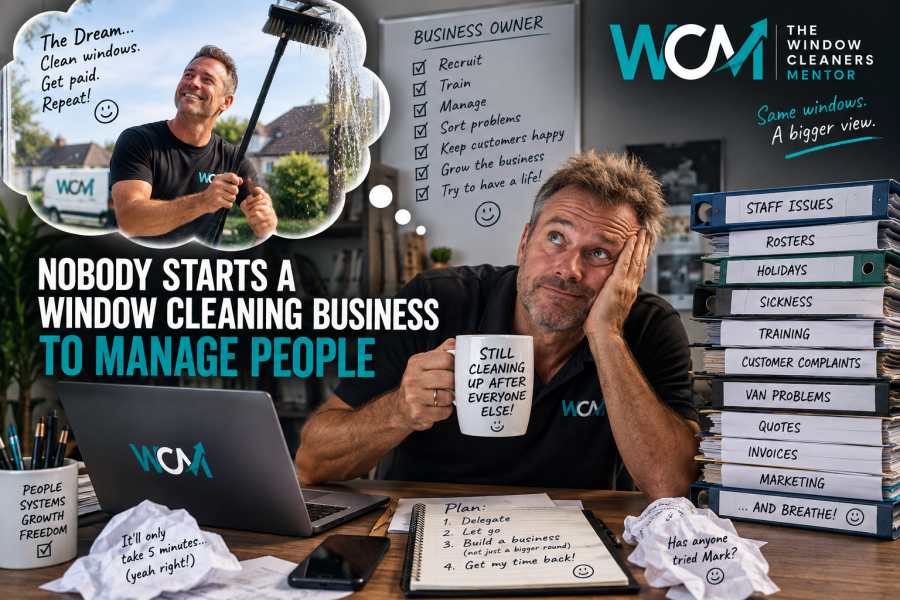
At no point did I sit there dreaming about staff appraisals, recruitment interviews, holiday requests and conversations beginning with:
“Mark, have you got five minutes?”
Because, as every business owner eventually discovers, it is never five minutes.
Back then, the business was simple.
I had customers. I cleaned their windows. If something went wrong, I knew exactly who was responsible.
Me.
Actually, thinking about it, that bit hasn’t changed quite as much as I’d hoped.
Then You Employ Someone
This is normally regarded as progress.
You’ve got too much work, so you employ your first window cleaner. Mine was Chris!
Suddenly, somebody else can do some of the work.
Excellent.
So naturally, you assume you’ll have more time.
You won’t.
You’ll just discover exciting new ways to fill it.
Then another van gets added. Another employee arrives. Before long, you’ve got three or four vans running around and you’re no longer worrying about whether Mrs Jones’s conservatory roof has been cleaned.
You’re worrying about wages, holidays, sickness, training, damaged equipment, customer complaints and why Van 3 appears to be consuming diesel at roughly the same rate as a small cross-Channel ferry.
Congratulations.
You’ve become a manager.
“I’ll Just Do It Myself”
This was one of the lessons I had to learn.
When you’ve built the business yourself, you know how things should be done.
You’ve probably cleaned thousands of windows. You’ve dealt with customers. You’ve priced jobs. You’ve made plenty of mistakes along the way.
Therefore, when somebody takes 20 minutes to do something you could do in five, there’s an overwhelming temptation to say:
“Give it here. I’ll do it.”
Which works brilliantly.
For about five minutes.
Because every time you take something back, you’re teaching the team something:
If I wait long enough, Mark will do it.
Eventually, you become the answer to every question in the business.
And that’s exhausting.
Your Employees Aren’t You
Here’s another slightly uncomfortable lesson.
Nobody will care about your business quite like you do.
And why should they?
They didn’t start it.
They haven’t spent Sunday evening looking at the bank account wondering whether everyone can be paid on Friday.
They don’t wake up at 3am suddenly remembering that a van needs an MOT.
That’s ownership.
However, good employees absolutely can care about doing a good job.
They can take pride in their work.
They can look after customers.
They can support each other.
And they can represent your company brilliantly.
But first, we have to give them clear expectations, proper training and enough responsibility to grow.
Sometimes they’ll get things wrong.
So will you.
I’ve been doing this for 30 years and I’m still managing to find new and interesting ways of getting things wrong.
Window Cleaner or Business Owner?
Eventually, every growing window cleaning business reaches a crossroads.
You have to decide what you’re actually trying to build.
Do you want to be a window cleaner with a really good round?
Nothing wrong with that whatsoever.
Or do you want to build a window cleaning business?
Because they’re not the same thing.
If you want four vans, five vans or ten vans, eventually your job can’t be cleaning more windows.
Your job becomes building the people and systems that allow other people to clean more windows.
That’s a very different skill.
Suddenly you need to become better at recruitment, training, communication, delegation and leadership.
You’ll also need to become comfortable with difficult conversations.
Unfortunately, there still isn’t an app that does those for you.
I’ve checked.
Try the 30-Day Test
Here’s something I’d encourage you to do.
Imagine that tomorrow you disappeared from your business for 30 days.
Not literally. That might cause unnecessary concern at home.
But suppose you couldn’t answer the phone, WhatsApp the team or quietly sort things out behind the scenes.
What would stop?
Would the vans still go out?
Would customers still be booked in?
Would quotes still be sent?
Would invoices get paid?
Would somebody deal with complaints?
Would the team know what to do?
Or would everyone simply stand in the office saying:
“Has anyone tried Mark?”
Those answers tell you something important.
They show you where you are still the system.
And if your ambition is to eventually get off the tools and build a business that gives you more freedom, those are the areas you need to start fixing.
Because employing people isn’t really about having more hands to clean windows.
It’s about learning to let other people take responsibility.
And that’s probably one of the hardest transitions we make as business owners.
You started out learning how to clean windows.
Eventually, you have to learn how to build a business that can clean them without you.
And strangely enough, nobody mentions that bit when you’re buying your first squeegee.
Then there’s the goverment that also have its hand in your pocket for Tax, NI contibutions, pension…. shall I go on?